Selamat datang di uzairsuhaimi.blog! Blog ini merekam jejak pemikiran penulisnya mengenai bidang sosial-ekonomi-kependudukan dan refleksinya mengenai kebijaksanaan abadi dalam perspektif Islam.
[Regardant par la fenêtre sans expression, Rumi murmure lentement …]
Rumi : Antum reconnaît-il différents chemins?
Un disciple : Juste un peu, Maître.
Rumi : Utilisez les yeux de votre coeur! Antum peut voir beaucoup de chemins là-bas. Il y en a de grands, certains petits. Certaines sont droites, d’autres sont tordues. Certains sont en sécurité, beaucoup sont vulnérables. Il y a même beaucoup de faux chemins là-bas.
[Le disciple se taisait mais préparait son cœur à recevoir les enseignements de son maître. Il sait que son maître aime utiliser un “langage d’oiseau” qui ne peut être compris que par des oreilles de coeur.]
Rumi : Savez-vous que le chemin le plus droit, le plus droit et le plus sûr est le Chemin d’Al-Mustafa.
[Parce que le disciple est juste silencieux alors Rumi continue.]
Rumi: Antum sait mon diplôme?
Un disciple: Pas très clair, Maître.
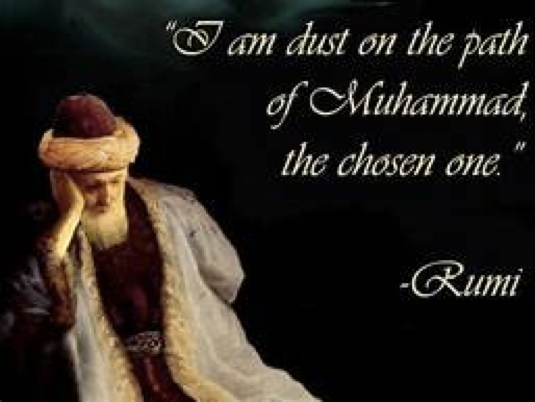
Rumi: Je ne suis que poussière sur le sentier Al-Mustafa. Mais j’ai eu la chance d’avoir un peu de parfum. Seulement un peu. Pouvez-vous le sentir?
Disciple : Très, Maître.
Rumi : Antum sait qui aime le plus Mustafa?
Disciple : Incertain, maître.
Rumi : Bilal. Après avoir été laissée par son amant, elle ne souhaitait plus appeler les gens pour la prière. Quand le calife l’a convaincu, il a esquivé: “Laissez-moi devenir un muezzin pour l’apôtre uniquement”, a-t-il déclaré. Il n’y avait aucun moyen de le forcer. Parce que, s’il est forcé, il ne pourra arriver qu’à cette partie: “waasyhadu anna Muhammadan ar-Rasuilullah”.
[En entendant cela, le disciple était stupéfait, essayant d’imaginer la situation. Voyant les étudiants rester silencieux, continua Rumi].
Rumi: Antum sait ce qui est le plus aimé et aimé par Al-Mustafa?
Un disciple : Juste un peu mais incertain, Maître.
Rumi: Mustadhafin et les orphelins.
Disciple : Mais ….
[Le disciple a omis de continuer sa protestation parce qu’il a vu le Maître sombrer dans la contemplation].
**Statistics and Spirituality: An Unexpected Synergy**
At first glance, the pairing of statistics and religion may seem unconventional—even paradoxical. One discipline is rooted in empirical analysis, quantifying the tangible realities of our world; the other contemplates the transcendent, exploring truths beyond the physical realm. Yet this very duality defines my journey: a lifelong dedication to statistical rigor intertwined with a deep fascination for humanity’s spiritual dimensions.
**Professional Journey: Three Decades of Data-Driven Impact**
From 1981 to 2011, I served as a statistician at *BPS-Statistics Indonesia*, the nation’s central bureau of statistics, contributing to data-driven policymaking and national development. Following this, I lent my expertise to Indonesia’s *TNP2K* (a Vice President’s Office initiative) and the *International Labour Organization’s Regional Office for Asia and the Pacific (ILO-ROAP)* as a senior statistician. Since 2012, I have operated as an independent consultant, collaborating with entities like the ILO and Indonesian government agencies on pivotal projects. A recent highlight includes leading Indonesia’s first comprehensive *estimation of child labor* for the ILO Country Office in Jakarta (2019), a critical step toward addressing this urgent social challenge.
**Spiritual Inquiry: Bridging the Universal and the Esoteric**
Parallel to my professional work, I have nurtured a decades-long intellectual passion for the essence of religious thought—its esoteric traditions, universal principles, and timeless wisdom. Sufism’s mystical teachings and the *perennial philosophy*, which seeks shared truths across spiritual traditions, hold particular resonance for me. To explore these themes, I have authored and shared reflections on my personal blog, inviting dialogue on how inner understanding intersects with our outer world.
**Convergence: Where Analysis Meets Meaning**
This unlikely harmony between data and devotion has profoundly shaped my perspective: statistics reveal the *"what"* of human conditions, while spirituality grapples with the *"why."* Together, they form a dynamic lens through which I seek to understand—and contribute to—both the measurable and the immeasurable dimensions of life.
.
View all posts by Uzair Suhaimi



 Jejak Pemikiran dan Refleksi
2 thoughts on “Dialogue Imaginaire avec Rumi (2)”