Selamat datang di uzairsuhaimi.blog! Blog ini merekam jejak pemikiran penulisnya mengenai bidang sosial-ekonomi-kependudukan dan refleksinya mengenai kebijaksanaan abadi dalam perspektif Islam.
[Looking out the window without expression Rumi mumble slowly …]
Rumi: Do Antum[1] recognize various paths out there?
Disciple: Just a little, Master.
Rumi: Use your heart’s eyes! Antum can see a lot of paths out there. There are big ones, some small ones. Some are straight, some are twisting. Some are safe, many are vulnerable. There are even many sham paths out there.
[The disciple just kept quiet but prepared his heart to receive the teachings from his master. He knows that his master likes to use “bird language”[2] which can only be understood by heart ears.]
Rumi: Do you know, the biggest, the straightest forward and the safest road is the Path of Al-Mustafa[3].
[Because the disciple is just silent then Rumi continues.]
Rumi: Antum knows my degree?
Disciple: Not very clear, Master.
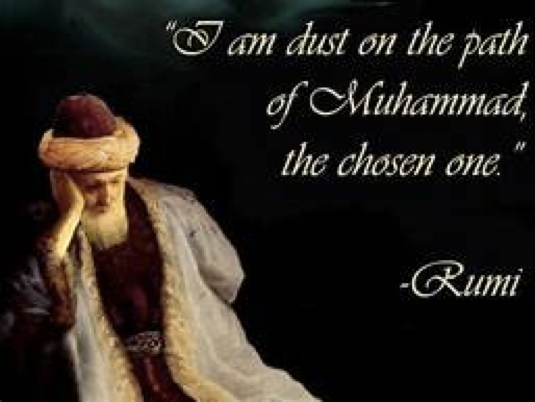
Rumi: I am just dust on the Al-Mustafa path. But I was lucky as blessed with a little fragrance. Only slightly. Can you smell it?
Disciple: Very, Master.
Rumi: Antum knows who loves Al-Mustafa the most?
Disciple: Uncertain, master.
Rumi: Bilal. After being left by her lover, she was no longer willing to call people for prayer. When the caliph persuaded him he dodged: “Let me become a Muezzin for the Apostle only,” he said. There was no way to force him. Because, if forced, he will only be able to arrive at this part: “waasyhadu anna Muhammadan ar-Rasulullah“.
[Hearing this the disciple was just stunned, trying to imagine the situation. Seeing the students stay silent, Rumi continued].
Rumi: Antum knows what is most loved and loved by Al-Mustafa?
[2] The term bird language (Arabic: mantiq al-thair) is used by holy texts to convey higher truths. The sacred text alludes to Solomon as a prophet who understands this language.
[3] Al-Mustafa (Arabic) means chosen (the chosen one). Rumi used to use this term to refer to the Prophet SAW.
[4] This term refers to marginalized groups in society, including the needy and the poor.
**Statistics and Spirituality: An Unexpected Synergy**
At first glance, the pairing of statistics and religion may seem unconventional—even paradoxical. One discipline is rooted in empirical analysis, quantifying the tangible realities of our world; the other contemplates the transcendent, exploring truths beyond the physical realm. Yet this very duality defines my journey: a lifelong dedication to statistical rigor intertwined with a deep fascination for humanity’s spiritual dimensions.
**Professional Journey: Three Decades of Data-Driven Impact**
From 1981 to 2011, I served as a statistician at *BPS-Statistics Indonesia*, the nation’s central bureau of statistics, contributing to data-driven policymaking and national development. Following this, I lent my expertise to Indonesia’s *TNP2K* (a Vice President’s Office initiative) and the *International Labour Organization’s Regional Office for Asia and the Pacific (ILO-ROAP)* as a senior statistician. Since 2012, I have operated as an independent consultant, collaborating with entities like the ILO and Indonesian government agencies on pivotal projects. A recent highlight includes leading Indonesia’s first comprehensive *estimation of child labor* for the ILO Country Office in Jakarta (2019), a critical step toward addressing this urgent social challenge.
**Spiritual Inquiry: Bridging the Universal and the Esoteric**
Parallel to my professional work, I have nurtured a decades-long intellectual passion for the essence of religious thought—its esoteric traditions, universal principles, and timeless wisdom. Sufism’s mystical teachings and the *perennial philosophy*, which seeks shared truths across spiritual traditions, hold particular resonance for me. To explore these themes, I have authored and shared reflections on my personal blog, inviting dialogue on how inner understanding intersects with our outer world.
**Convergence: Where Analysis Meets Meaning**
This unlikely harmony between data and devotion has profoundly shaped my perspective: statistics reveal the *"what"* of human conditions, while spirituality grapples with the *"why."* Together, they form a dynamic lens through which I seek to understand—and contribute to—both the measurable and the immeasurable dimensions of life.
.
View all posts by Uzair Suhaimi



 Jejak Pemikiran dan Refleksi
One thought on “Imaginary Dialogue with Rumi (2)”