Selamat datang di uzairsuhaimi.blog! Blog ini merekam jejak pemikiran penulisnya mengenai bidang sosial-ekonomi-kependudukan dan refleksinya mengenai kebijaksanaan abadi dalam perspektif Islam.
Kita Tau Dunia Lagi Kacau, Ini Akar Masalahnya (Bukan Cuma Politik!)
Krisis iklim, kesenjangan sosial, perang—kita sering mikir solusinya cuma lewat teknologi atau kebijakan. Tapi menurut Islam, semua chaos ini ternyata punya satu akar yang sama: penyakit spiritual.
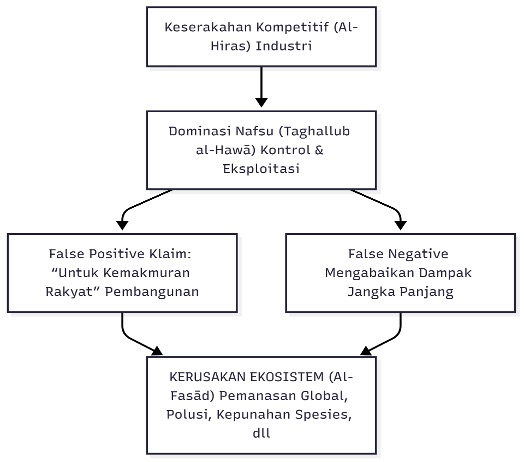
Penyakitnya dirangkum dalam “Segitiga Keruntuhan Spiritual”:
Al-Hiras (Keserakahan Kompetitif): Gaya hidup “balikin story lu, gue unggah!”. FOMO yang bikin kita eksploitasi bumi dan saingin terus. QS. At-Takatsur: 1-2 udah ngingetin soal ini.
Taghallub al-Hawā (Nafsu yang Jadi Raja): Pas keinginan duniawi jadi komandan, akal sehat & hati nurani kita dicuekin. Ini yang psikologi bilang the dictatorship of desires. QS. Yusuf: 53 ngingetin kalo nafsu emang jagonya suruh jahat.
Al-Fasād (Kerusakan Sistemik): Ini hasil akhirnya. Yang parahnya, para perusak malah ngaku diri mereka “reformis”. Mengeksploitasi alam? “Ini buat pembangunan!”. Nindas yang lemah? “Ini buat stabilitas!”. Mereka udah ilang rasa realitas (QS. Al-Baqarah: 11-12).
Akibatnya? Krsis Lingkungan dan Krisis Sosial. Bagaimana hal itu bisa terjadi? Lihat aja Diagram 1 dan Diagram 2.
Trus, ada harapan nggak? PASTI ADA.
Islam punya konsep #Fitrah . Sebelum lahir ke dunia, jiwa kita sudah melekat bahwa Allah itu Tuhan. Artinya, kompas moral buat bedain bener-salah sudah tertanam di dalam diri kita. Cuma aja, sering ketutup debu keserakahan dan kelalaian.
Tugas kita adalah “membersihkan debu” itu. Balik ke jati diri. Nabi Muhammad SAW juga ngasih kita jaminan lewat QS. Az-Zumar: 53: “Janganlah berputus asa dari rahmat Allah.”
Jadi, solusinya dimulai dari kita. Gerakan pensucian jiwa (tazkiyatun nafs) bukan hanya membuat diri sendiri, tapi untuk mendorong perubahan sistem yang lebih adil dan berkelanjutan. Mari sembuhkan diri kita sendiri untuk menyembuhkan dunia.
**Statistics and Spirituality: An Unexpected Synergy**
At first glance, the pairing of statistics and religion may seem unconventional—even paradoxical. One discipline is rooted in empirical analysis, quantifying the tangible realities of our world; the other contemplates the transcendent, exploring truths beyond the physical realm. Yet this very duality defines my journey: a lifelong dedication to statistical rigor intertwined with a deep fascination for humanity’s spiritual dimensions.
**Professional Journey: Three Decades of Data-Driven Impact**
From 1981 to 2011, I served as a statistician at *BPS-Statistics Indonesia*, the nation’s central bureau of statistics, contributing to data-driven policymaking and national development. Following this, I lent my expertise to Indonesia’s *TNP2K* (a Vice President’s Office initiative) and the *International Labour Organization’s Regional Office for Asia and the Pacific (ILO-ROAP)* as a senior statistician. Since 2012, I have operated as an independent consultant, collaborating with entities like the ILO and Indonesian government agencies on pivotal projects. A recent highlight includes leading Indonesia’s first comprehensive *estimation of child labor* for the ILO Country Office in Jakarta (2019), a critical step toward addressing this urgent social challenge.
**Spiritual Inquiry: Bridging the Universal and the Esoteric**
Parallel to my professional work, I have nurtured a decades-long intellectual passion for the essence of religious thought—its esoteric traditions, universal principles, and timeless wisdom. Sufism’s mystical teachings and the *perennial philosophy*, which seeks shared truths across spiritual traditions, hold particular resonance for me. To explore these themes, I have authored and shared reflections on my personal blog, inviting dialogue on how inner understanding intersects with our outer world.
**Convergence: Where Analysis Meets Meaning**
This unlikely harmony between data and devotion has profoundly shaped my perspective: statistics reveal the *"what"* of human conditions, while spirituality grapples with the *"why."* Together, they form a dynamic lens through which I seek to understand—and contribute to—both the measurable and the immeasurable dimensions of life.
.
View all posts by Uzair Suhaimi


 Jejak Pemikiran dan Refleksi